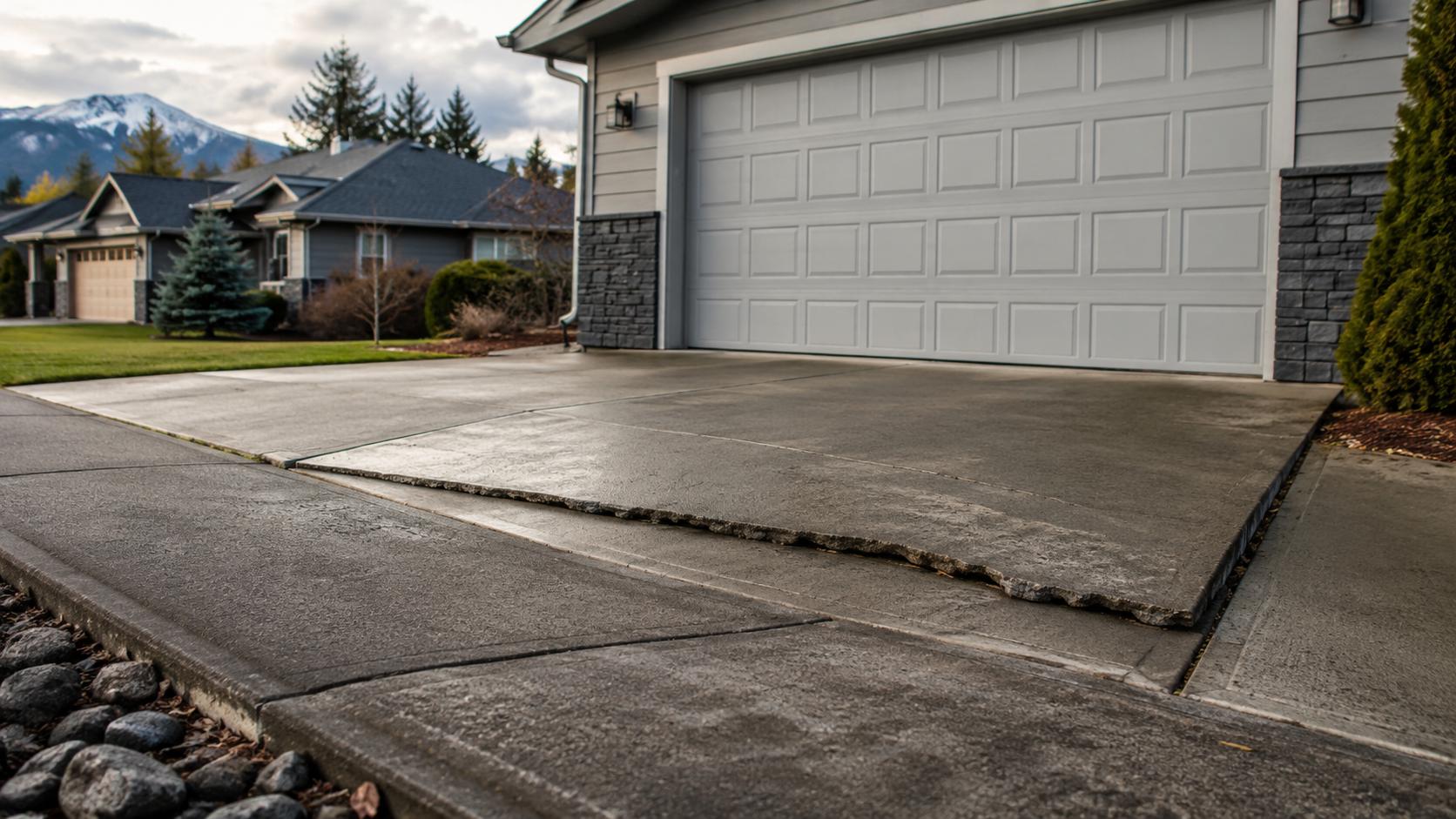
What Are Voids Under Concrete, and Why Should Fraser Valley Property Owners Pay Attention?
Voids under concrete are hidden gaps that form between the underside of a slab and the soil that is supposed to support it. They are almost always invisible from the surface. A driveway, garage floor, or warehouse slab can look perfectly solid while a cavity grows underneath, and by the time cracking, unevenness, or sinking shows up on top, the erosion below is usually well underway. What looks like a minor cosmetic crack can be the first visible sign of a much larger problem hiding just inches down.
The Fraser Valley is especially prone to this. Much of the region sits on clay-rich soils that swell when saturated and shrink in dry spells, a cycle that gradually opens gaps beneath slabs. Heavy seasonal rain drives erosion under foundations and washes fine soil out along slab edges. Add decades of rapid development, some of it on ground that was never compacted properly, and void formation from Abbotsford to Chilliwack becomes less a question of if than when.
This post walks through how voids form, how they grow, how they can be detected without tearing the concrete apart, and how filling and stabilization restore solid ground before the surface fails.
Why Fraser Valley Soil and Climate Set the Stage
The valley floor is a layered mix of silty clay, alluvial deposits left by rivers over thousands of years, and organic-rich lowland soils shaped by decades of agriculture. These layers do not behave the same way under load. Organic material breaks down and loses volume over time, and fill placed over it can keep settling for years after construction ends.
The climate compounds it. Wet winters saturate the ground while a high water table pushes moisture up toward the slab. Summer then dries the same clay-heavy soils until they shrink away from the underside of the concrete. Every pass through this shrink-swell cycle can pull a little more support out from under a slab, the same seasonal mechanics behind why foundations crack more in a dry summer than a wet winter. Floodplain soils near the Fraser and Vedder rivers add one more layer of risk. They are naturally loose, seasonally saturated, and prone to shifting, so subsurface support in these areas is an ongoing condition to manage rather than a one-time detail.
Five Mechanisms That Carve Out Empty Space
Water washout under the slab
Moving water carries fine soil particles with it. When water finds a path beneath a slab, through a shrinkage crack, an open joint, or a poorly drained edge, each pass removes a little more material. Small, persistent flows can relocate a surprising volume of soil over months and years, and eventually the slab has nothing solid to rest on. In a region with this much seasonal rainfall, washout is one of the most common drivers of slab settlement.
Poor original compaction
This one is built in on day one and hides for years. When fill is not compacted properly before the pour, the loose soil slowly consolidates under the slab's weight and settles unevenly, leaving gaps behind. Settlement of this kind tends to start subtle, then accelerate once water finds its way into the developing spaces.
Decomposing organic fill
If roots, stumps, or old topsoil were never fully removed before fill was placed, that organic material keeps breaking down under the concrete. As it decomposes it loses mass, and the space it occupied becomes void. The process is slow, but the resulting gaps can be substantial, especially on older properties where site preparation standards were looser than they are today.
Utility trench erosion
The backfill around water, sewer, and electrical lines is almost never as dense as the undisturbed soil beside it, so trenches become preferred paths for underground water movement. As water travels these corridors it washes out fine particles and creates elongated voids that can extend well past the trench itself, sometimes right under a slab or footing.
Erosion along the foundation
Poor grading, downspouts discharging at the wall, or a rising water table send water along the outside of foundation walls and footings, where it slowly pulls soil away from underneath. In the wet season, sustained rainfall keeps the ground saturated and the water moving, so this process can run for months at a time without leaving a visible trace.
How Voids Grow When Nothing Is Done
A void rarely stays the size it started. Every rain event pushes more water and more fine soil through the same paths. Every shrink-swell cycle loosens the soil's grip a little further. Traffic from vehicles and equipment compacts weakened soil down into the cavity. And the problem feeds itself: a larger void channels more water and flexes more under load, recreating the exact conditions that formed it.
While that happens, the slab above is acting like a bridge. Concrete is strong in compression but weak in flexure, so a slab spanning an unsupported gap holds steady until the span gets wide enough that an everyday load cracks it and drops it. That can play out gradually over years or all at once under one heavy vehicle.
Settlement rarely stops at the concrete either. Once a slab drops, walls can crack, doors stick in their frames, tile pops, and drainage slopes reverse and send water back toward the structure, feeding the very erosion that started the problem. Fixing the water and soil problems before touching the surface is the difference between a repair that lasts and one that repeats, which is why we wrote about why the order of repairs matters as much as the repairs themselves.
Finding a Void Without Tearing the Concrete Apart
Visual inspection alone cannot confirm a void, because the slab surface hides everything. Fortunately there are reliable ways to see below without demolition.
The simplest is sounding, or hammer-tap testing. Tapping systematically across a slab, solid, well-supported concrete returns a sharp ringing tone while hollow areas sound dull and drummy. It is low-tech, but it is a fast way to flag suspect zones for a closer look.
For a detailed picture, ground-penetrating radar is the standard non-destructive tool. A GPR unit sends short radio pulses into the concrete and soil, and when a pulse hits a change in density, such as the boundary between compacted soil and an air gap, it reflects back to a receiver. The result is a map of voids and loose zones beneath the slab without a single cut. Once GPR flags a problem area, targeted probe drilling confirms the exact size and depth of the void before any repair is planned.
Void Filling and Stabilization: Restoring Solid Ground
Filling a void is not about plugging an empty space. The goal is restoring the bearing capacity the soil originally provided and stopping the movement that created the gap.
Polyurethane injection is the modern standard for this. Small ports are drilled through the slab, polyfoam grout is pumped into the cavity, and the material expands to fill spaces of any shape, then cures to a rigid, load-bearing foam within minutes rather than days. There is no excavation, no heavy equipment on the lawn, and the surface is typically back in use the same day. We walked through the full process in what polyfoam grout is and how we use it to restore concrete.
The stabilization happens in the same step. As the foam expands it also permeates and consolidates the loose soil around the void, locking weakened material into a more stable matrix. That matters because the void is often just the symptom, and the soil around it is the actual problem.
A complete repair also looks past the void itself. If drainage failures, washout, or grading problems carved out the cavity, they need correcting as part of the job, or the settlement comes back. On every project we evaluate the full picture, including grading, drainage, and soil conditions, so the void filling holds for the long term instead of buying a few seasons.
If concrete on your property sounds hollow underfoot, is cracking, or has started to sink, an assessment now is far cheaper than a repair after the surface lets go. Reach out to Black Birch Contracting and we can take a look at what is happening underneath.
Frequently Asked Questions
What are the early warning signs of voids under concrete?
Early signs include hairline cracks on the slab surface, sections of concrete that feel hollow or flex slightly when walked on, and uneven or sunken areas on driveways, garage floors, or walkways. Because voids are hidden beneath the surface, many property owners don't notice a problem until the damage is already well advanced. Catching these signs early and arranging slab void detection can prevent far more costly repairs later.
Why are voids under concrete so common in the Fraser Valley?
The Fraser Valley sits on a complex mix of silty clay, alluvial deposits, and organic-rich soils that shift, decompose, and erode over time. The region's wet winters and dry summers create a repeated shrink-swell cycle in clay soils, gradually pulling support away from the underside of concrete slabs season after season. That combination of unstable soil types and dramatic moisture swings makes void formation a widespread problem from Abbotsford to Chilliwack.
How does water cause voids to form beneath a concrete slab?
When water flows beneath a concrete slab, it gradually carries fine soil particles away in a process known as water washout. Over many cycles of saturation and drainage, enough material is removed to leave significant hollow spaces beneath the slab. Poor drainage, damaged gutters, and the Fraser Valley's heavy seasonal rainfall all increase the risk of this type of void formation.
Is it safe to keep using a concrete surface that has voids underneath it?
Generally, no. A slab without full soil support can crack, sink, or shift suddenly under load, which is a real hazard for people, vehicles, and equipment. Addressing voids early through filling and stabilization protects both the structure above and the people using it.
Can voids under concrete be fixed without replacing the entire slab?
In many cases, yes. Void filling under a concrete slab lets contractors inject material into hollow spaces and restore soil support without tearing out and replacing the concrete entirely. The right approach depends on the size and location of the void, the condition of the slab, and the underlying soil. A professional assessment is the sensible first step.
Does poor original construction contribute to voids forming under concrete?
Yes. Inadequate soil compaction during original construction is one of the key contributing factors to void formation. When ground isn't properly prepared before a slab is poured, settlement and shifting can begin relatively quickly as the soil continues to compress or erode beneath the concrete. We've seen this firsthand on properties that are only a few years old, which is why void problems show up in newer builds just as often as older ones across the Fraser Valley.
Voids under concrete are a serious concern for Fraser Valley property owners, but catching them early makes a real difference in the cost and complexity of repairs. If you've noticed cracking, uneven surfaces, or sinking concrete on your property, reach out to our team at Black Birch Contracting to get a professional assessment and find out what options are available to you.