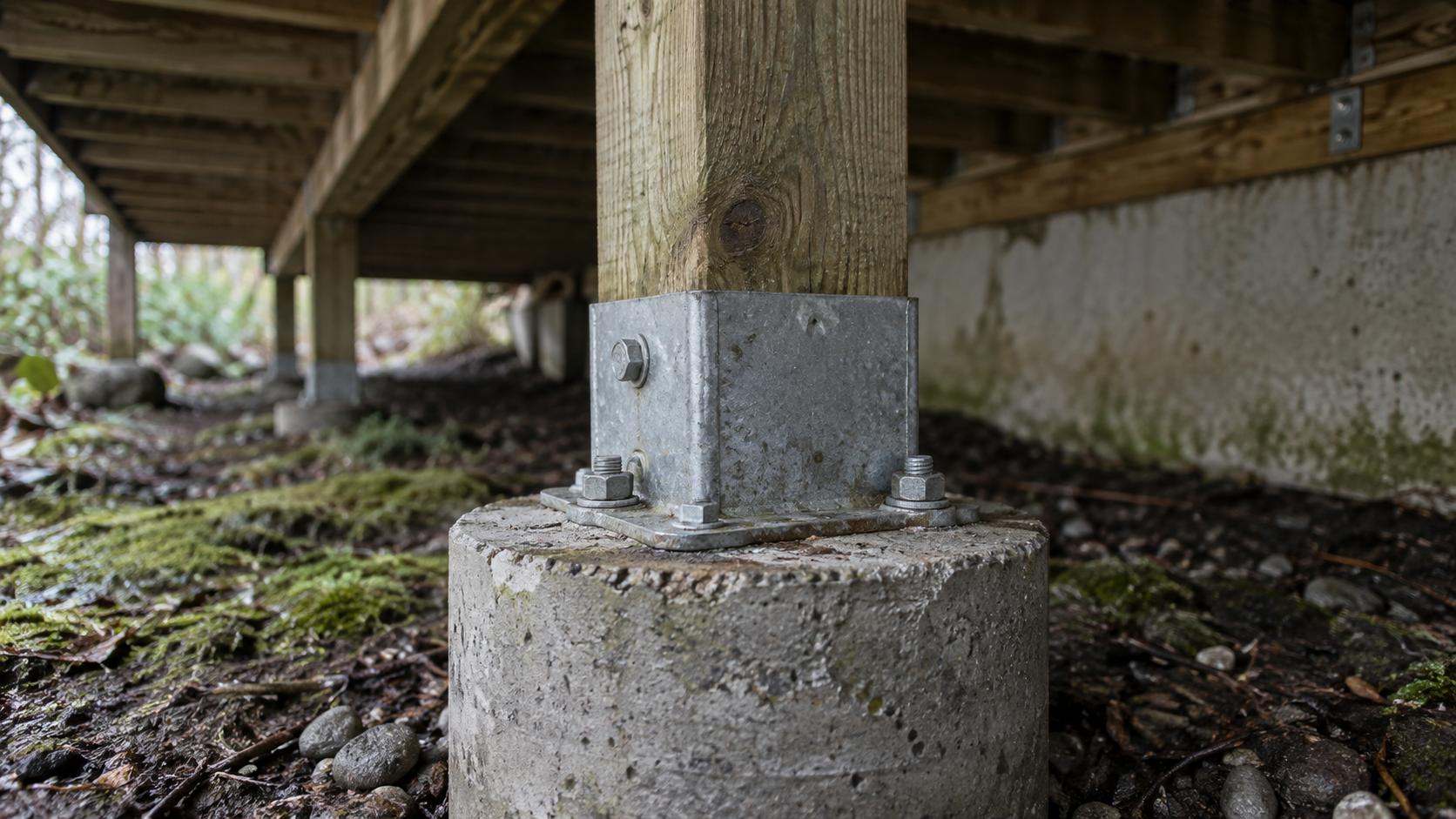
Most deck failures are not the boards. Decking and railings show wear plainly and get replaced on schedule. The parts that actually drop a deck are the ones nobody looks at: the connection to the house, the hardware at the posts, and the footings in the ground. All three are hidden, all three degrade quietly, and in a climate as wet as the Fraser Valley they degrade faster than most owners expect.
The Ledger Connection
The ledger is the board fastened to the house that carries one entire side of the deck. When a deck comes down, this is usually where it lets go, and it rarely fails slowly enough to give warning.
Fasteners are the first issue. Nails alone were never adequate for a ledger and are still found on older decks. Proper attachment uses through-bolts or approved structural screws in a specified pattern, sized and spaced for the load. The second issue is what the ledger is attached to. It has to land on solid framing, meaning the house rim joist, not siding, not brick veneer, and not sheathing alone. A ledger fastened to a rim joist that has already softened from water is carrying load on material that cannot hold it.
Flashing and Water Entry
Almost every rotted ledger traces back to missing or failed flashing. Without it, water runs down the wall, gets behind the ledger, and stays there. The wood dries slowly, sits wet through the season, and rot works outward from the hidden face where nobody sees it.
Flashing over the top of the ledger, directing water out and over rather than behind, is what prevents this, and it has to integrate with the wall assembly rather than being tucked in afterwards. It is the first thing worth checking on an older deck, because it explains most of the other damage.
Posts, Beams, and Bearing
Load moves from the deck framing into beams, from beams into posts, and from posts into footings. Every handoff needs hardware that matches the load path. Toenailed connections, and beams resting on top of a post without a cap, are common on older decks and are weak in exactly the direction that matters.
Notching a post to accept a beam is another frequent shortcut. Done properly, with the beam bearing on the shoulder of the notch and through-bolted, it works. Done as a partial notch with the beam effectively hanging on the bolts, the fasteners carry the load in shear instead of the wood carrying it in bearing.
Bounce is worth attention. A deck that moves underfoot is reporting something about span or connection, much as a bouncy floor indoors reports on the structure below it.
Footings and Frost Depth
A deck post is only as good as what it sits on. Footings need to bear on undisturbed soil capable of carrying the load, and to sit below the local frost depth so seasonal freezing cannot lift them. Frost depth on the coast is shallower than in the Interior, but shallow is not the same as irrelevant.
Precast blocks set on the surface are common on older and owner-built decks. They can suit a low freestanding platform in some situations and are inadequate for anything attached to a house or raised well off the ground. Where footings do move, the mechanism is the same upward movement that lifts concrete rather than settling it.
Guard and Railing Attachment
Guards are a life-safety component and they fail differently from the rest of the deck. A guard has to resist a person falling against it, which is a lateral load applied at the top of a post, and that creates significant leverage at the connection down at the bottom.
The old approach of bolting a notched post to the outside face of the rim joist is weak, because the notch removes wood precisely where bending stress is highest. Better practice ties the post back into the deck framing with blocking and hardware rather than relying on two bolts through a thinned post.
Inspecting an Older Deck
A useful inspection starts underneath, not on top. Look at the ledger where it meets the house and probe the wood with a screwdriver; if it sinks in easily, the ledger is compromised. Check whether flashing exists above it. Look at every post-to-beam and beam-to-joist connection for real hardware rather than nails. Check posts at ground level, where rot starts, and look for footings that have tilted or lifted.
Decks in the Fraser Valley are generally permit work once they reach a certain height or attach to the house, so a rebuild is worth checking against local requirements before it is priced. Anything showing ledger rot, missing hardware or moving footings should come out of use until it has been assessed, rather than being patched cosmetically.
Frequently Asked Questions
How long should a deck last in the Fraser Valley?
The surface and the structure age on different schedules. Decking and railings are consumable and get replaced as they weather. The framing, ledger and footings should last far longer, but in a wet climate that depends almost entirely on whether water was kept out of the connections at the time of construction. A deck with proper flashing and hardware can outlive several rounds of decking; one without flashing can have a compromised ledger in well under a decade.
What are the warning signs that a deck is unsafe?
Movement is the main one. Sway when you walk, a guard that flexes when leaned on, or a deck pulling visibly away from the house all indicate a structural problem rather than a cosmetic one. Add to that soft or spongy wood where the deck meets the house, rust streaks or missing hardware at connections, and posts or footings that have shifted out of plumb. Any of these warrants keeping people off the deck until it is looked at.
Can a rotted ledger be repaired without rebuilding the whole deck?
Often yes. The ledger, the flashing and the affected rim joist can usually be addressed while the rest of the structure stays in place, provided the framing beyond the connection is still sound. What determines the scope is how far the water travelled. If rot has moved into joists or into the house framing behind the ledger, the repair grows accordingly, and that is not visible until the area is opened up.
Do deck footings really need to go below frost depth?
For anything attached to the house, yes. If a footing sits within the zone that freezes, seasonal ground movement can lift it, and because that lifting is uneven it racks the structure and stresses the connection at the house. Freestanding low platforms are treated differently, but an attached or elevated deck should have footings bearing below frost depth on soil that can carry the load.
A deck is a structure, and the parts that keep it standing are the ones you cannot see from the top of it. If yours moves, feels soft where it meets the house, or is simply old enough that nobody knows how it was built, Black Birch Contracting can assess it and tell you honestly whether it needs a repair or a rebuild. Reach out anytime.